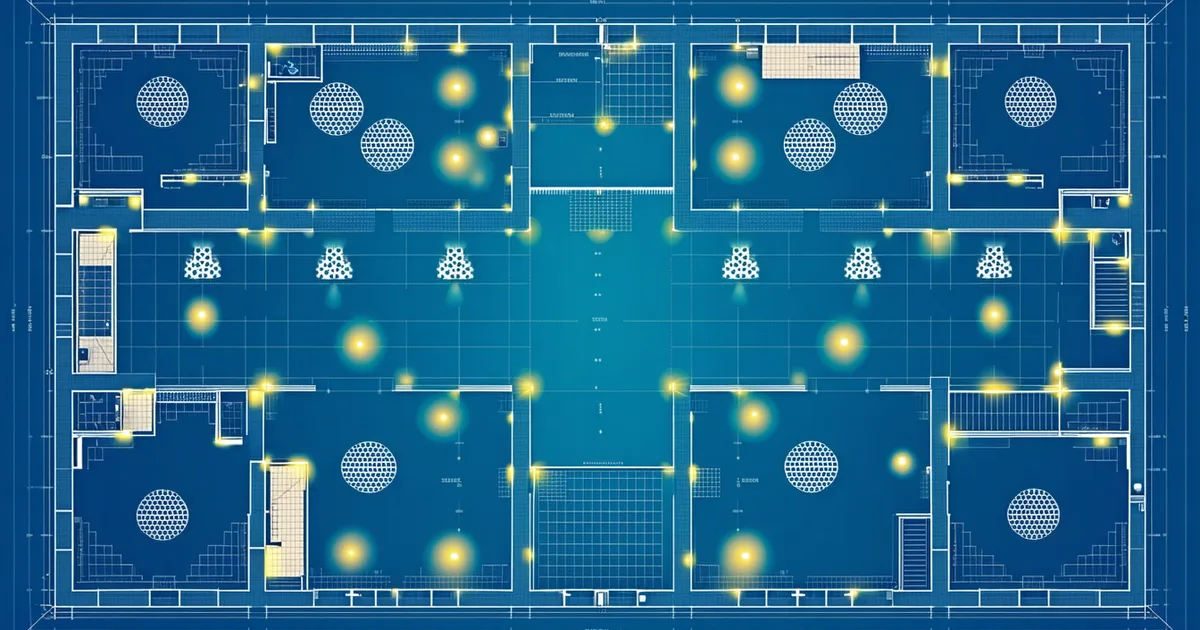
The most expensive mistake in private 5G deployment is placing antennas before you model coverage. Every site survey team that has reworked a deployment mid-installation knows the pain: two gNodeBs already ceiling-mounted, power run, and you find out on day three that the steel rack row between Zones B and C is blocking the signal path you assumed was clean.
Predictive RF modeling doesn't eliminate that problem completely — no model is perfect against the reality of a live industrial environment. But it reduces the surprise factor significantly before a single anchor bolt goes into concrete. This article covers how to set up a meaningful coverage model, which inputs actually drive accuracy, and what post-deployment validation tells you that the model cannot.
What a predictive RF model actually does
A predictive RF heat map is a computational estimate of received signal strength (typically expressed as SINR in dB) across your facility, given a set of cell positions, transmission parameters, and environmental inputs. The model doesn't measure anything — it calculates propagation from first principles using the path loss model appropriate for your band (3.5 GHz CBRS in most industrial private cellular deployments).
The standard path loss model for indoor industrial environments is the 3GPP InH-Industrial scenario defined in 3GPP TR 38.901. This model was specifically developed for factory hall and warehouse environments and accounts for the dense metallic structure characteristics that separate industrial facilities from office building propagation. It models:
- Free-space path loss at 3.5 GHz (path loss exponent approximately 1.6–1.8 in line-of-sight industrial corridors)
- Wall and partition attenuation per material type
- Diffraction around obstruction edges (limited; indoor industrial models are primarily attenuative rather than diffractive)
- Shadow fading with a log-normal standard deviation of 7–8 dB in non-line-of-sight industrial conditions
Output is a SINR map per cell, overlaid on your floor plan. You're looking for zones where predicted SINR falls below your target threshold — typically 10–15 dB for the device classes you're deploying. Anything below 6 dB is considered unreliable for 5G NR modulation at useful MCS levels. Below 3 dB, expect persistent HARQ retransmissions and effective throughput collapse.
The floor plan inputs that drive accuracy
The model is only as accurate as its inputs. For an industrial facility, three inputs dominate model accuracy: ceiling height, wall and obstruction materials, and major structural features. Everything else is second-order.
Ceiling height. CBRS cells in industrial facilities are typically ceiling-mounted or mounted at structural beam height. The antenna height relative to the device height (1–1.5 m above floor for AGVs; 0.8–1.2 m for sensors mounted on low fixtures) determines the vertical component of the free-space path. A 9 m ceiling versus a 6 m ceiling is not just 3 m of additional free-space loss — it changes the angle of incidence on rack rows and fundamentally alters reflection and diffraction paths through the rack structure. Measure ceiling height per zone, not as a single facility average. Mezzanine areas and partial high-bay sections need separate zone modeling.
Wall and obstruction materials. Per-material attenuation values at 3.5 GHz:
- Reinforced concrete (exterior walls, structural pillars): 15–25 dB per penetration
- Standard drywall on steel stud (interior partition): 4–8 dB
- Steel shelving / pallet rack (aisle-to-aisle, fully loaded): 10–20 dB depending on depth and product density
- Standard glass (interior windows, office partitions): 3–5 dB
- Steel-frame glass curtain wall: 8–15 dB (the steel frame dominates the attenuation, not the glass)
- HVAC ductwork at 6 m: 2–6 dB depending on duct diameter and orientation relative to signal path
Don't estimate these from photographs or drawings. Walk the facility and record actual construction types with a measuring tape and material notation. A single misclassified reinforced concrete pillar row — entered as drywall partition — can shift a cell placement recommendation by 10–15 m and convert an apparent coverage overlap into a gap that only shows up during commissioning.
Major structural features frequently missed. Metal mezzanine decks and overhead crane rails are the two most commonly omitted obstructions in initial models. A mezzanine deck at 4 m effectively partitions your facility into two vertically separate coverage zones. The signal attenuation through the steel grating is typically 12–20 dB, depending on deck construction. An overhead crane rail run at 5 m creates a linear attenuator along its entire travel path — the shadow zone below the rail can have SINR 6–10 dB lower than the surrounding floor area, which matters directly for devices operating in the crane's path.
Cell placement: coverage-first, not grid-first
Start with your coverage requirement, not the ceiling grid. The most common planning mistake is placing cells at regular spacing based on vendor-recommended inter-site distances — 30 m, or whatever the deployment guide says. Vendor deployment guides are written for generic environments using average assumptions. Your environment has specific obstructions that invalidate uniform spacing assumptions in specific zones.
The correct placement sequence
- Define your SINR target per zone: ≥ 15 dB in AGV travel corridors, ≥ 12 dB in pick aisles with active AGV traffic, ≥ 10 dB in storage and break areas. These thresholds should map to your device class requirements, not generic best practices.
- Run the model with a single cell at each candidate position, in isolation — no inter-cell interference. Identify the coverage contour at your target SINR threshold for that cell.
- Place the next cell at the edge of the previous cell's contour, adjusted for the specific obstruction geometry in that zone.
- Repeat iteratively until the floor plan is covered.
- Run the multi-cell model to identify overlap zones. Target 10–15 dB SINR overlap for reliable intra-gNodeB handover. Less than 5 dB of overlap creates handover failure zones; more than 20 dB creates excessive adjacent-cell interference on shared CBRS channels.
The overlap analysis is where most placement decisions get made. Insufficient overlap creates handover failures — visible as AGV disconnections at specific corridor positions. Excessive overlap creates uplink interference hotspots when multiple cells compete for resource block allocation from devices that can "see" both equally. Both are visible and correctable in the SINR map before you commission any hardware.
What the model consistently underestimates
We're not saying predictive modeling is a substitute for post-deployment validation — it isn't. Three categories of real-world behavior that static models consistently miss:
Dynamic interference from industrial equipment. Forklift charger banks, induction welding systems, and plasma cutting equipment generate broadband RF emissions that the model has no visibility into. The model assumes a background noise floor of approximately −100 dBm. A plasma cutter 15 m from your cell can elevate that floor by 10–15 dB during operation. The model doesn't know your production schedule, and it can't predict which equipment will be running during your peak AGV traffic hours. Budget for post-live tuning as a first-class task, not a remediation step.
Device antenna characteristics. The 3GPP InH-Industrial model assumes an isotropic receive antenna at the UE. AGV antennas are not isotropic — they're often low-mounted (0.8–1.2 m), frequently shielded on one or more sides by the vehicle chassis, and may have a directional pattern that depends on vehicle heading. A model may predict adequate SINR at a corridor intersection while the actual device, with its antenna null facing the nearest cell during a left turn, drops below threshold. Confirm AGV antenna specifications and orientation constraints with the vehicle vendor before finalizing cell placement.
Load-dependent SINR variation. The model produces a snapshot under assumed loading. In practice, uplink interference from multiple devices in the same cell increases with traffic load. A pick aisle with 12 AGVs active during shift peak has materially different uplink noise characteristics than the same aisle during off-peak hours. Design to your peak load scenario — the 15th percentile traffic load will take care of itself.
Validating with a structured walktest
Once cells are installed and powered, before declaring the deployment ready for production, run a structured walktest. Use a CBRS-capable UE or your actual deployment device (if it exposes SINR reporting) and walk each AGV travel corridor at the target device height. Record measured SINR at 3–5 m intervals.
Compare measured SINR against your model predictions for the same measurement points. An acceptable model-to-measurement delta is ±5 dB across 80% of points. Systematic deviations above ±10 dB in a specific zone indicate a misconfigured model input — typically a missed obstruction, incorrect material attenuation value, or an unaccounted antenna mounting constraint. Fix the model input, not just the cell position, so the model remains accurate for future layout changes.
The coverage model should be a living document. When the facility adds a new rack row, expands a mezzanine, or reroutes an AGV travel lane, the model needs to be updated before the physical change goes live. The gap between a changed facility layout and an updated coverage model is where most post-commissioning SLA failures originate.